1. Do you have a clear brand strategy?
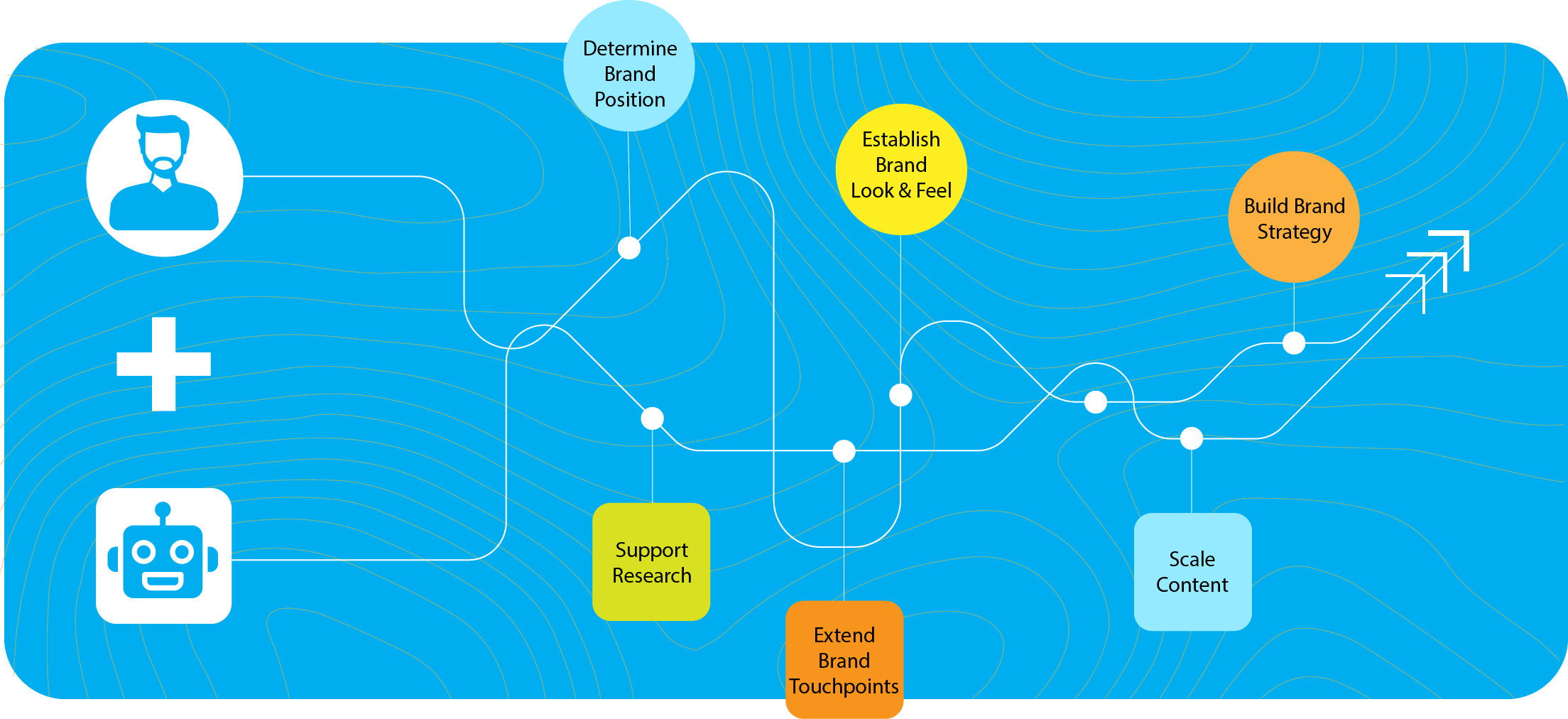
A strong brand strategy serves as your map. It defines where your organization is headed and establishes the principles that keep every decision aligned along the way.
That foundation should guide everything from positioning and messaging to visual identity, customer experience and content strategy. It gives your team a shared understanding of what the brand stands for, how it should communicate and what makes it meaningfully different.
AI can help bring those decisions to life, but it can’t make them for you. If your tone of voice is unclear, it may produce content that appears polished, but is inauthentic or irrelevant. If your positioning is underdeveloped, it may generate seemingly credible ideas that could just as easily belong to a competitor. If your audience is not well understood, it may simply create more content without creating greater relevance.
Before asking AI to communicate on behalf of your brand, you first need to determine what your brand should say and why anyone should care.
2. Do you know where AI can help you move forward?
Today, AI is exceptionally good at identifying patterns, organizing information and generating possibilities. It can support research, uncover connections and help teams be consistent. Used well, it creates more space for people to focus on higher-value decisions. But its strengths now also reveal its limits.
AI excels in applying existing patterns and gravitating toward the most likely response. That makes it less capable of producing the strategically distinct point of view that separates a memorable brand from an interchangeable one.
At the same time, expertise in AI (or at least experimentation) is widely accessible. Tasks that once required specialized knowledge can now be attempted by almost anyone with the right platform and prompt. As access expands, the technology itself becomes less of a competitive advantage. When everyone has access to the same tools, the tools stop being the differentiator. Instead, your perspective, judgment and brand become the differentiator. The goal isn’t to let AI choose the path. It’s to use AI to help you travel it more effectively.
3. Do you know when humans must lead?
AI can create something technically acceptable. The writing can be grammatically correct. The imagery can be considered clean to the untrained eye. Yet even to the general public something can still feel uncanny. We call this the “AI sheen.” This kind of work, repeated at scale, can gradually erode differentiation. Consistency gives way to uniformity and efficiency begins to come at the expense of identity.
This is where humans matter most. People recognize nuance, challenge assumptions and know when something simply doesn’t feel right for the brand. Without that challenge, AI can reinforce existing assumptions and confirmation bias rather than introduce the perspective a brand needs to move forward. AI can’t understand your organization’s culture or the trust you’ve built with your audience. And it won’t always deliver the hard truth a brand needs to hear.
Getting on the right path.
Technology is always evolving. New tools emerge, and capabilities that seem extraordinary today eventually become ordinary. Organizations continue experimenting, learning and deciding where AI fits within their work.
Companies that navigate this AI revolution most successfully will be the ones that take a more strategic approach, follow a strong brand map and keep humans at the center of every important decision. After all, the real quest isn’t simply to adopt AI. Rather, it’s to grow revenue more efficiently without losing what built your brand following in the first place.